
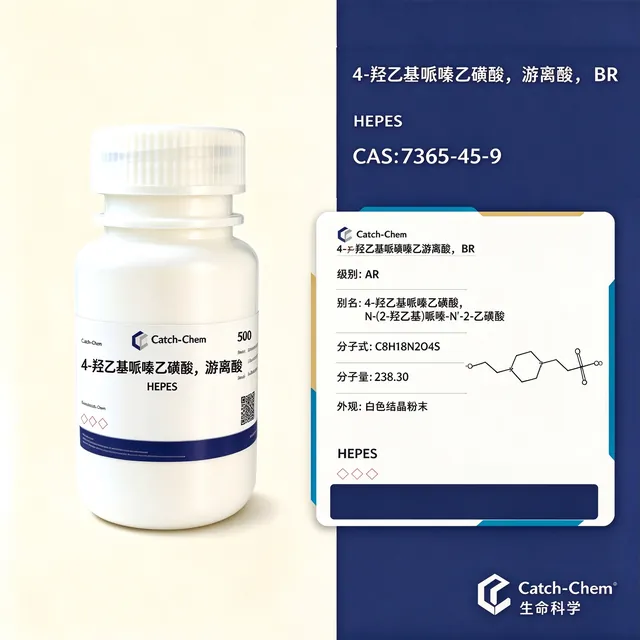
- Chinese name
- HEPES 游离酸
- English name
- HEPES (4-(2-hydroxyethyl)piperazine-1-ethanesulfonic acid)
- CAS
- 7365-45-9
- Listed grade
- AR / BR
- pKa, literature
- 7.56 at 25 °C; about 7.43 at 37 °C. Useful range about pH 6.8–8.2
- Form
- Free-acid powder
- Documents
- COA / SDS on request
HEPES is the Good's buffer most often used in mammalian culture, commonly 10–25 mM in medium, and it is also used to set pH in IVD reagents. Metal binding is weaker than phosphate or citrate, but it is not zero for copper and some other metals. Old solutions can form peroxides, so keep them dark.
What it is
HEPES is a zwitterionic piperazine ethanesulfonic acid, one of the buffers described by Good and co-workers for biological work. Its pKa sits close to physiological pH, it does not permeate membranes easily, and it binds most divalent metals only weakly. Unlike bicarbonate, it holds pH without a CO2 atmosphere.
Where it is used
- Cell culture: typically 10–25 mM in medium, often alongside bicarbonate, to keep pH stable while plates are outside the incubator.
- IVD and immunoassay reagents: diluents and conjugate buffers, usually 10–50 mM around pH 7.0–7.6.
- Protein purification, crystallization and enzyme assays that need a near-neutral buffer with low metal binding.
- How it compares with MES, MOPS and Tris is covered in choosing a buffer.
Handling tips
- Dissolve the free acid in water and titrate with NaOH to the target pH at the working temperature; the pKa drops by roughly 0.014 per °C.
- HEPES-containing media exposed to light can generate hydrogen peroxide, especially with riboflavin present. Store solutions dark and cold.
- Filter-sterilize (0.22 µm) stocks intended for culture.
What to specify when ordering
- Free acid, or the sodium / hemisodium salt (sodium salt often CAS 75277-39-3).
- AR or BR, and whether a cell-culture tested grade is required.
- Powder or sterile 1 M stock, and the pack size.
Properties and storage
- Formula
- C8H18N2O4S
- Molecular weight
- 238.30
- Appearance
- White crystalline powder
- Solubility
- Freely soluble in water (about 400 g/L at 20 °C)
- Storage
- Room temperature, dry, sealed, dark; solutions 2–8 °C protected from light
- Typical packs
- 25 g, 100 g, 500 g, 1 kg; bulk on request
Typical literature values. The batch COA / SDS governs.
Before you inquire
Where do the pKa values come from?
7.56 and 7.43 are literature values at 25 °C and 37 °C.
Is a sterile stock available?
Powder and sterile stock can both be inquired. For a stock, give the concentration and pH.
Does HEPES replace bicarbonate?
Not entirely. Most media still need bicarbonate as a nutrient, and HEPES adds extra buffering capacity.
Pack sizes and catalogue numbers
HEPES, free acid, AR
CTH10015A-1KG
Prices on request; lead time confirmed on the quotation.
HEPES, free acid, BR
CTH10015B-1KG
Prices on request; lead time confirmed on the quotation.
Request a quote for HEPES free acid
Name the salt form, grade, pack size and use. We compare sources and reply.
Send an inquiryFor research or industrial use only. Not for human or animal diagnosis or treatment, and not for drug or food use. Grade, pack size and lead time follow the supplier batch COA / SDS. Figures on this site are general industry references, not a factory specification.