
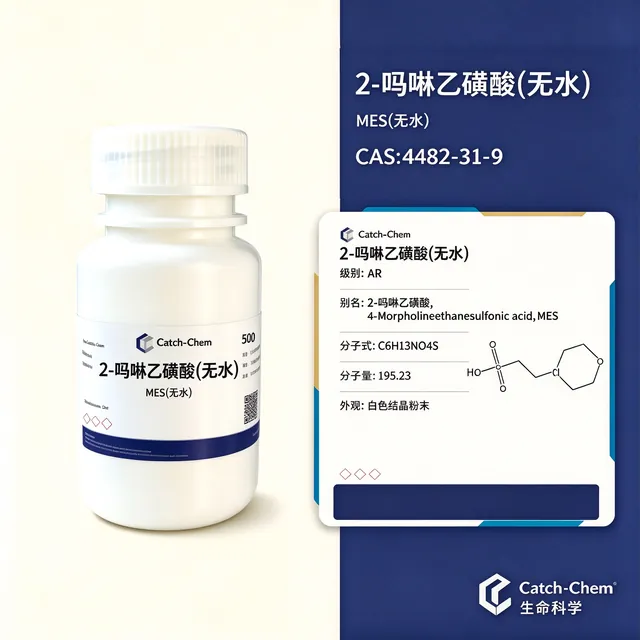
- CAS
- 4432-31-9 anhydrous; monohydrate often 145224-94-8
- pKa, literature
- 6.27 at 25 °C; about 6.16 at 37 °C
- Form
- Anhydrous, monohydrate, and sodium, potassium or hemisodium salts are separate rows
MES is the Good's buffer for mildly acidic work, including plant media and some enzyme reactions. Catch-Chem quotes the solid. Please name the hydrate and the salt form.
What it is
MES (2-(N-morpholino)ethanesulfonic acid) is a morpholine Good's buffer with a useful range of about pH 5.5–6.7. It binds Ca2+, Mg2+ and Mn2+ negligibly, absorbs little in the UV, and contains no primary amine, so it does not compete in carbodiimide coupling.
Where it is used
- EDC/NHS coupling of proteins to beads or surfaces, commonly in 0.1 M MES at pH 4.7–6.0.
- MES-SDS running buffer for Bis-Tris gels, typically 50 mM MES, to resolve small and mid-size proteins.
- Plant tissue culture and hydroponic media, where a few mM MES holds a mildly acidic pH.
- Cation-exchange chromatography and enzymes with acidic optima.
Handling tips
- Titrate the free acid with NaOH or KOH; the salts dissolve closer to the working pH.
- Solutions can yellow slightly over time or on autoclaving; filter-sterilize and store cool and dark.
- Weigh by the correct molecular weight for anhydrous or monohydrate.
What to specify when ordering
- Anhydrous (4432-31-9) or monohydrate (often 145224-94-8).
- Free acid, or sodium, potassium or hemisodium salt.
- Grade and pack size. See the pKa table, or HEPES when the target is closer to neutrality.
Properties and storage
- Formula
- C6H13NO4S
- Molecular weight
- 195.24 (anhydrous)/ 213.25 (monohydrate)
- Appearance
- White crystalline powder
- Solubility
- Freely soluble in water
- Storage
- Room temperature, dry, sealed
- Typical packs
- 25 g, 100 g, 500 g; bulk on request
Typical literature values. The batch COA / SDS governs.
Before you inquire
Are anhydrous and monohydrate the same CAS?
No. The monohydrate is commonly 145224-94-8. Adjust the weighed mass for the extra water, about 195.2 versus 213.2 g/mol.
Why MES rather than phosphate for EDC coupling?
Phosphate and amine buffers take part in or slow the carbodiimide reaction. MES has neither a carboxylate nor a primary amine, so the activation step stays efficient.
Can MES be used near pH 7?
It buffers poorly above about pH 6.7. For neutral work, MOPS or HEPES is the usual choice.
Pack sizes and catalogue numbers
MES, anhydrous
CTH10069-1KG
Prices on request; lead time confirmed on the quotation.
MES monohydrate
CTH10070-1KG
Prices on request; lead time confirmed on the quotation.
Request a quote for MES
Name the salt form, grade, pack size and use. We compare sources and reply.
Send an inquiryFor research or industrial use only. Not for human or animal diagnosis or treatment, and not for drug or food use. Grade, pack size and lead time follow the supplier batch COA / SDS. Figures on this site are general industry references, not a factory specification.