
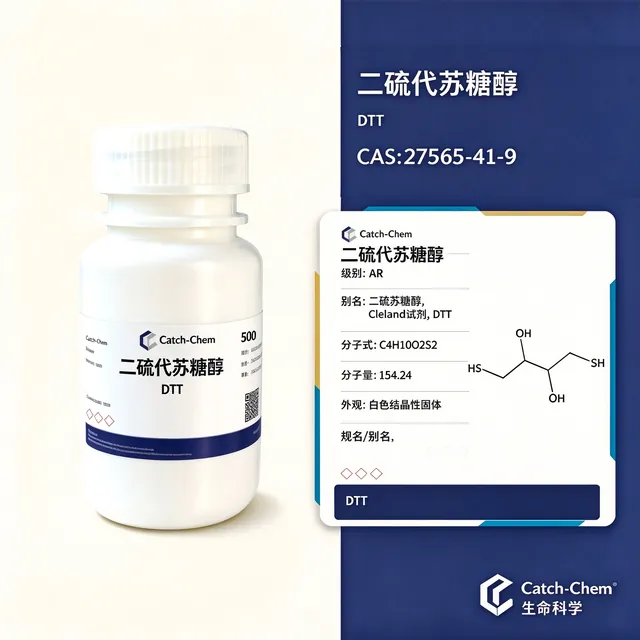
- CAS
- 27565-41-9
- Role
- Disulfide reduction and RNase inhibition
- Handling
- Solutions are frozen and not freeze-thawed repeatedly
DTT is the reductant on both IVD formulas and nucleic-acid extractions. Catch-Chem quotes it as a raw material.
What it is
DTT (dithiothreitol, Cleland's reagent) is a dithiol reducing agent. After reducing a disulfide it closes into a stable six-membered ring, which drives the reaction to completion and makes it far more effective than 2-mercaptoethanol at equal concentration. It works best above pH 7, since the reactive species is the thiolate.
Where it is used
- Protein buffers and purification, typically 1–10 mM to keep cysteines reduced.
- SDS-PAGE sample buffer, commonly 50–100 mM to break disulfides before loading.
- Proteomics: reduction at about 5–10 mM before alkylation with iodoacetamide.
- Enzyme reaction buffers, including reverse transcription, and nucleic-acid lysis mixes with guanidine isothiocyanate.
Handling tips
- DTT oxidizes in air. Make a 1 M stock in water, aliquot and store at −20 °C; avoid repeated freeze-thaw.
- Keep DTT low (about 1 mM or less) with Ni-NTA resins, which it can reduce.
- Store the powder cold, dry and sealed; it has a noticeable sulfur odor.
What to specify when ordering
- Purity and grade (general or molecular biology).
- Solid or ready solution with concentration.
- Pack size.
Properties and storage
- Formula
- C4H10O2S2
- Molecular weight
- 154.25
- Appearance
- White crystalline powder with a faint thiol odour
- Solubility
- Freely soluble in water and ethanol
- Storage
- 2–8 °C, dry, sealed; solutions aliquoted at −20 °C, avoid freeze–thaw
- Typical packs
- 1 g, 5 g, 25 g, 100 g
Typical literature values. The batch COA / SDS governs.
Before you inquire
How should DTT solutions be stored?
Prepare fresh or freeze in aliquots; avoid repeated freeze-thaw.
DTT or TCEP?
TCEP is odorless, more stable in air and works at lower pH, but it is more expensive. DTT remains the common choice for routine buffers and sample loading.
Can DTT replace 2-mercaptoethanol?
Usually yes, at a lower concentration. About 50–100 mM DTT replaces 5% 2-mercaptoethanol in sample buffer.
What is the molecular weight of DTT?
About 154.25 g/mol, so a 1 M stock is roughly 1.54 g in 10 mL.
Pack sizes and catalogue numbers
CTH10019-100G
Prices on request; lead time confirmed on the quotation.
Request a quote for DTT
Name the salt form, grade, pack size and use. We compare sources and reply.
Send an inquiryFor research or industrial use only. Not for human or animal diagnosis or treatment, and not for drug or food use. Grade, pack size and lead time follow the supplier batch COA / SDS. Figures on this site are general industry references, not a factory specification.