
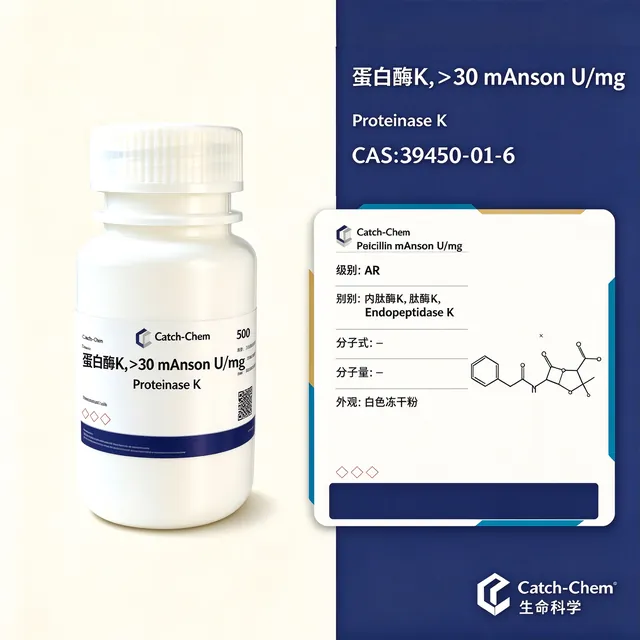
- CAS
- 39450-01-6
- Activity
- >30 mAnson U/mg; the batch COA governs
- Ask separately
- Molecular-biology grade, DNase-free, RNase-free, native or recombinant
Proteinase K often stays active in SDS, urea and EDTA, which is why extraction protocols use it to digest tissue protein and nucleases. The greater-than-30 mAnson U/mg figure is the specification floor; the batch COA reports the lot.
What it is
Proteinase K is a subtilisin-family serine protease of about 29 kDa from the fungus Engyodontium album (formerly Tritirachium album). It cleaves broadly, preferring sites next to hydrophobic and aromatic residues. Calcium stabilizes it, but it keeps useful activity in EDTA, SDS and urea, and works well at 50–65 °C.
Where it is used
- Genomic DNA extraction from tissue, blood and cells, typically 100–200 µg/mL in SDS-containing lysis buffer at about 55 °C.
- RNA and viral nucleic-acid preparation, where it digests nucleases in guanidine-based lysis.
- Removing protein from enzymatic reactions or plasmid preps, commonly around 50 µg/mL.
- Antigen and target retrieval for in situ hybridization, usually at low µg/mL. See nucleic acids.
Handling tips
- Store a 20 mg/mL stock in buffered 50% glycerol with calcium at −20 °C.
- Heat (about 95 °C for 10 min) reduces activity but may not inactivate it completely; PMSF gives irreversible inhibition.
- Enzyme dust can sensitize the airways; avoid breathing the powder.
What to specify when ordering
- Activity requirement and molecular-biology grade.
- DNase-, RNase- and nickase-free testing, and native or recombinant.
- Lyophilized powder or glycerol solution, and pack size. See what to ask.
Properties and storage
- Formula
- —
- Molecular weight
- about 28.9 kDa
- Appearance
- White to off-white lyophilized powder
- Solubility
- Soluble in water or Tris buffer (20 mg/mL is typical)
- Storage
- Powder 2–8 °C or −20 °C; solution aliquoted at −20 °C
- Typical packs
- 100 mg, 500 mg, 1 g, 5 g
Typical literature values. The batch COA / SDS governs.
Before you inquire
Is the activity a guarantee?
It is the listed floor. The COA reports the lot.
Does EDTA inactivate Proteinase K?
No. Removing calcium reduces its thermal stability somewhat, but the enzyme stays active, which is why it pairs well with EDTA-containing lysis buffers.
What is a typical digestion?
Tissue is often digested overnight at 55–56 °C. Cultured cells often need 1–3 hours.
Pack sizes and catalogue numbers
CTH10037-1G
Prices on request; lead time confirmed on the quotation.
Request a quote for Proteinase K
Name the salt form, grade, pack size and use. We compare sources and reply.
Send an inquiryFor research or industrial use only. Not for human or animal diagnosis or treatment, and not for drug or food use. Grade, pack size and lead time follow the supplier batch COA / SDS. Figures on this site are general industry references, not a factory specification.