
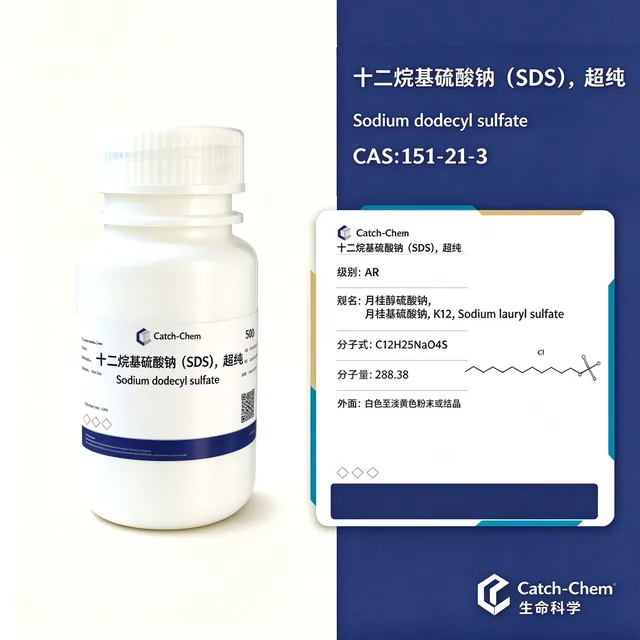
- CAS
- 151-21-3
- Grade
- Ultra-pure
- Ask on the COA
- Peroxide and metals
- Handling
- Avoid breathing the dust
Ultra-pure SDS is the detergent for SDS-PAGE. LDS is the cold-system alternative on the electrophoresis page. Tris is a separate buffer.
What it is
SDS (sodium dodecyl sulfate, sodium lauryl sulfate) is an anionic detergent with a C12 chain. It binds proteins at roughly 1.4 g per g of protein, unfolding them and giving a near-uniform negative charge per unit mass, so SDS-PAGE separates by size. Its critical micelle concentration in water is about 8 mM.
Where it is used
- SDS-PAGE: 0.1% in Tris-glycine running buffer and gels, and about 2% in 1× Laemmli sample buffer.
- Lysis buffers, for example 0.1% in RIPA, and stronger 1% denaturing lysis.
- DNA extraction with Proteinase K, commonly 0.5–1% SDS.
- Plasmid alkaline lysis, where 1% SDS is combined with NaOH.
Handling tips
- SDS precipitates in the cold and with potassium ions; keep 10–20% stocks at room temperature and avoid potassium-rich buffers.
- The powder is a respiratory and eye irritant. Weigh with a mask or in a ventilated enclosure.
- SDS also precipitates with guanidinium; remove guanidine before loading gels.
What to specify when ordering
- Purity and electrophoresis grade, with peroxide and metal limits.
- Powder, pellets or ready 10% / 20% solution.
- Pack size. Tris and LDS are on the electrophoresis page.
Properties and storage
- Formula
- C12H25NaO4S
- Molecular weight
- 288.38
- Appearance
- White powder or needles
- Solubility
- Soluble in water (about 100 g/L); precipitates in the cold
- Storage
- Room temperature, dry, sealed; dust is irritant, wear a mask when weighing
- Typical packs
- 100 g, 500 g, 1 kg
Typical literature values. The batch COA / SDS governs.
Before you inquire
SDS or LDS?
Routine room-temperature SDS-PAGE uses SDS; LDS stays soluble in cold systems.
Why does purity matter for SDS?
Commercial SDS can contain C10–C16 homologs, dodecanol and metals. These shift band migration and can affect sensitive assays, so electrophoresis work asks for a high-purity C12 grade.
How do I remove SDS from protein?
Common options are acetone or TCA precipitation, detergent-removal resins, or potassium precipitation of the dodecyl sulfate.
Pack sizes and catalogue numbers
CTH10026-1KG
Prices on request; lead time confirmed on the quotation.
Request a quote for SDS, ultra-pure
Name the salt form, grade, pack size and use. We compare sources and reply.
Send an inquiryFor research or industrial use only. Not for human or animal diagnosis or treatment, and not for drug or food use. Grade, pack size and lead time follow the supplier batch COA / SDS. Figures on this site are general industry references, not a factory specification.